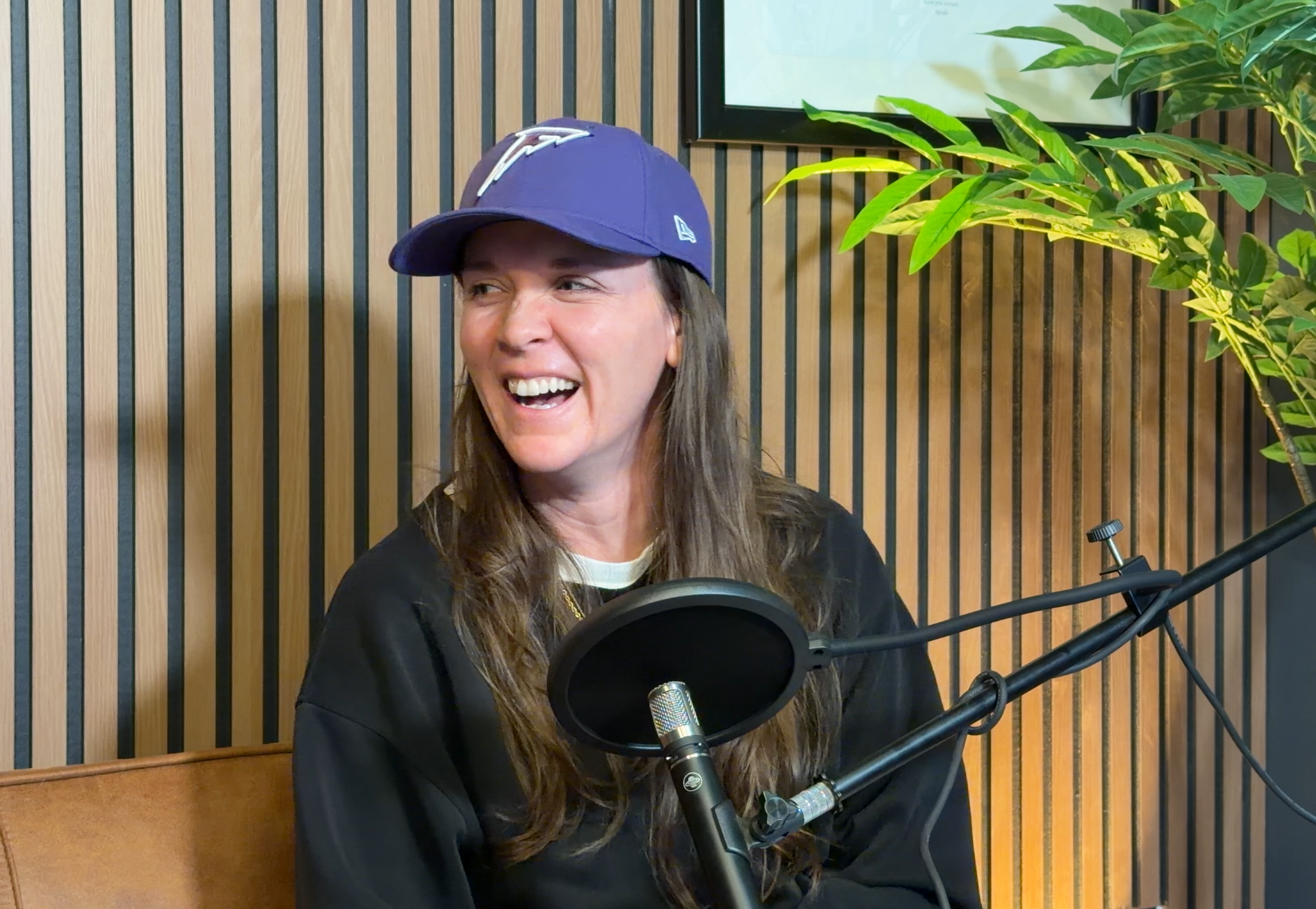
Caitlin
Host
Caitlin grew up in Atlanta, where the 1996 Olympics weren’t just on TV — they were down the street. She was young, but she remembers it: the USWNT competing on home soil, the gymnasts, the track athletes. Something clicked that didn’t unclick. Women’s sports became a through line she’s carried ever since, through all-state goalkeeper honors in high school, through a kinesiology degree at Wisconsin and a master’s at Minnesota, through years of coaching girls club soccer and serving as the goalkeeping coach at her alma mater. She has spent most of her adult life, in some form, in the orbit of women competing and what it takes to support them well.
Her professional path has wound through strength and conditioning, sports nutrition, CrossFit, and eventually the corporate world, where she now serves as a senior chief of staff overseeing a $100M book of business. The kinesiology training never really left her. She spent years studying how the body’s systems — cardiovascular, musculoskeletal, metabolic — work in concert, and how stress on one ripples through the rest. She thinks about organizations the same way now: talent as muscle, culture as connective tissue, strategy as the nervous system holding it together. It’s a lens sharpened by years of financial data analysis — she’s the kind of person who finds the story in a spreadsheet before she finds it anywhere else. When she looks at women’s sports through that same lens, the numbers don’t lie: viewership is up, investment is accelerating, and the growth curve is steep and still climbing. The athleticism has never been the question. The systems built around it — investment, infrastructure, media, opportunity — are where the work is, and where the opportunity is too.
That belief shapes what she brings to the podcast, and why she thinks representation in the conversation matters as much as representation on the field. Women’s sports has historically been covered, analyzed, and debated mostly by men — often good men, often well-meaning, but still. There’s something different about women telling these stories: the players who fought for locker rooms and living wages, the coaches who built programs with nothing, the pioneers who held the door open so the next generation could walk through it a little more easily. Caitlin had women like that in her life. She wants to be one for her two daughters.
The podcast was actually Alex’s idea — her husband, her co-host, and the person who pitched it to her as something they could build together. It took her six months to say yes. But there’s something she’s come to appreciate about that origin story: this is a show about elevating women, co-created by a man who already understood why that mattered before they ever hit record. He saw it in the athletes they cover, in the coaches and pioneers they research, and in his wife and daughters at home. That’s the kind of partnership worth building a podcast around, and if you spend any time listening, you’ll probably hear it.